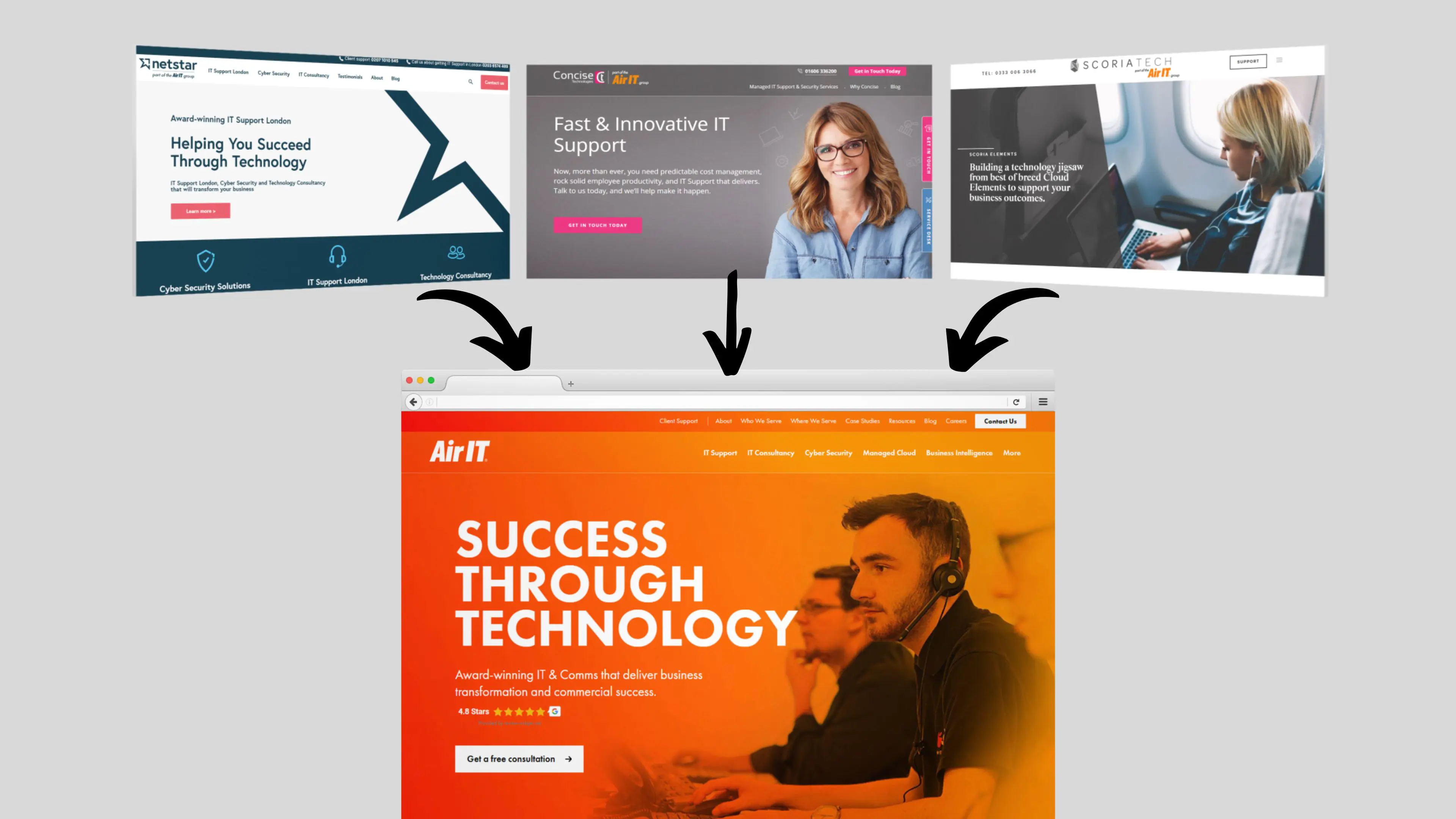
Air IT is one of the UK’s largest managed IT service providers. Backed by August Equity, the company had grown rapidly through acquisition - absorbing 13 separate businesses in a short period. Each acquisition brought a standalone website, its own branding, a different content management system, and its own domain authority.
The result was 13 websites saying different things about what was now a single company. Service descriptions overlapped. Brand messaging was inconsistent. Prospective clients searching for Air IT online were as likely to land on a legacy site as the main one. And internally, the marketing team was stretched across 13 separate platforms - maintaining, updating, and troubleshooting sites that were never designed to work together.
There was a practical risk too. A poorly handled migration could destroy the organic search rankings that each legacy site had built over years. Several of those domains carried significant authority in their local markets. Losing that traffic would mean losing visibility at exactly the point the business needed to present a unified, credible presence.
The Head of Marketing was clear about the brief: consolidate everything under a single Air IT brand, without losing the search performance or local relevance each acquired business had built.
"We had 13 websites telling 13 different stories about one business. Clients were confused, our own team was stretched, and we were spending money maintaining platforms that should have been retired years ago. The consolidation gave us a single presence that reflects who we are now - and when we acquire the next business, we know exactly how to bring them in. That was worth as much as the cost savings."
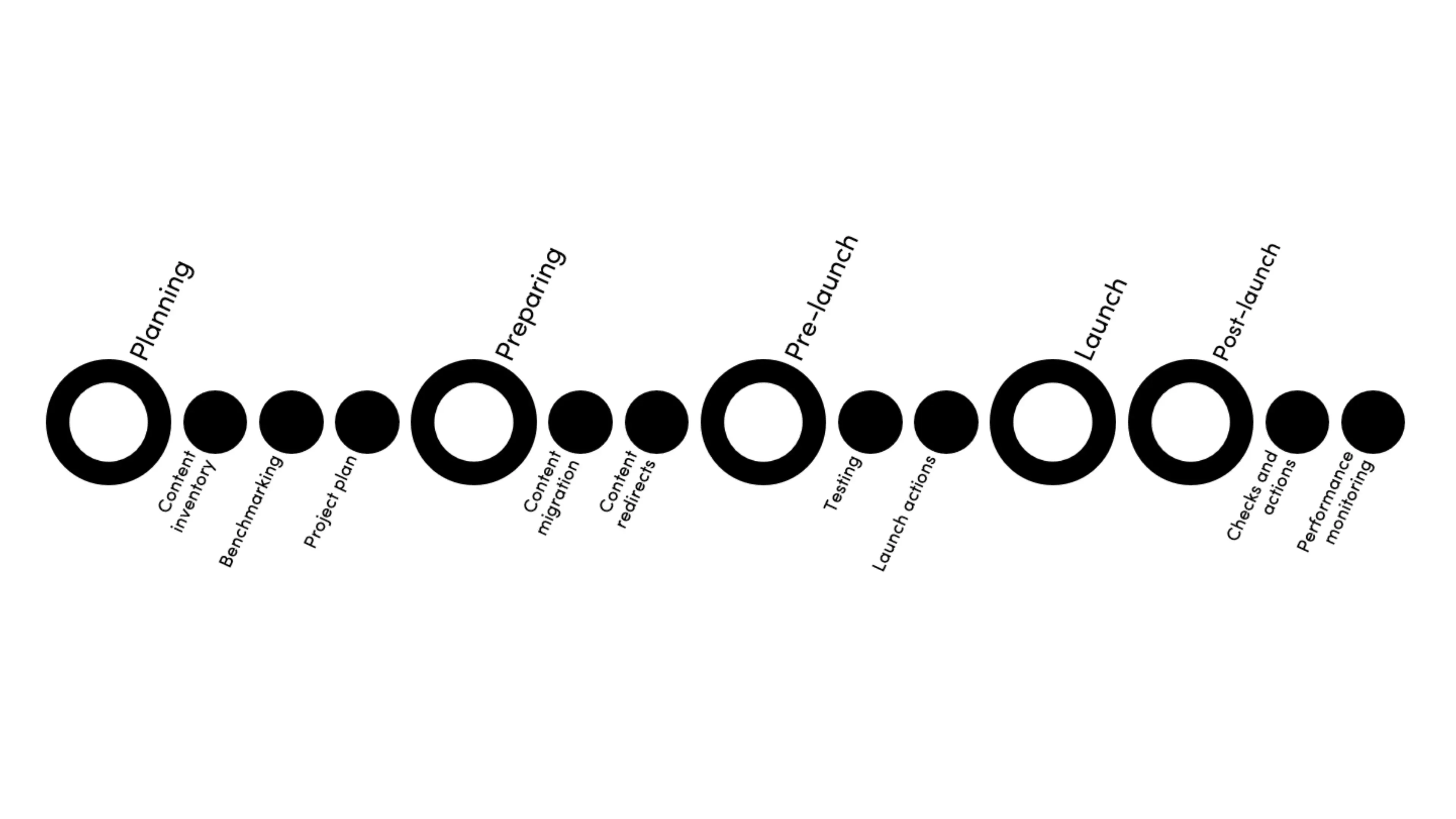
We started with a thorough review of all 13 websites. For each site, we audited traffic sources, identified high-value pages and backlinks worth preserving, and assessed which content was still relevant, which was duplicated, and which could be retired. That review gave us a clear picture of what needed to be protected and what could go.
From there, we designed a phased consolidation plan. Rather than attempting a single large-scale migration - which would have been high-risk and disruptive - we migrated one site at a time, each within a two-week window. This gave us the control to manage each transition carefully and the flexibility to adjust the approach as we learned from each phase.
For each migration, the work followed the same disciplined structure. We mapped key services, messaging, and regional presence into the Air IT brand without losing the local identity that mattered to existing clients. Every legacy URL was redirected to its correct equivalent on the new platform using a comprehensive 301 redirect strategy, preserving organic rankings and ensuring no visitor hit a dead end. Content was consolidated - removing duplication, aligning service descriptions, and bringing everything up to the quality standard of the unified brand.
The consolidated platform was built on WordPress, chosen for its scalability and the marketing team’s familiarity with it. The architecture was designed to handle future acquisitions without requiring a new project each time - a critical consideration for a business that intended to keep growing.
Each migration was monitored in real time. Traffic, rankings, and conversion rates were tracked before, during, and after every cutover. If something moved in the wrong direction, we caught it early and corrected it.
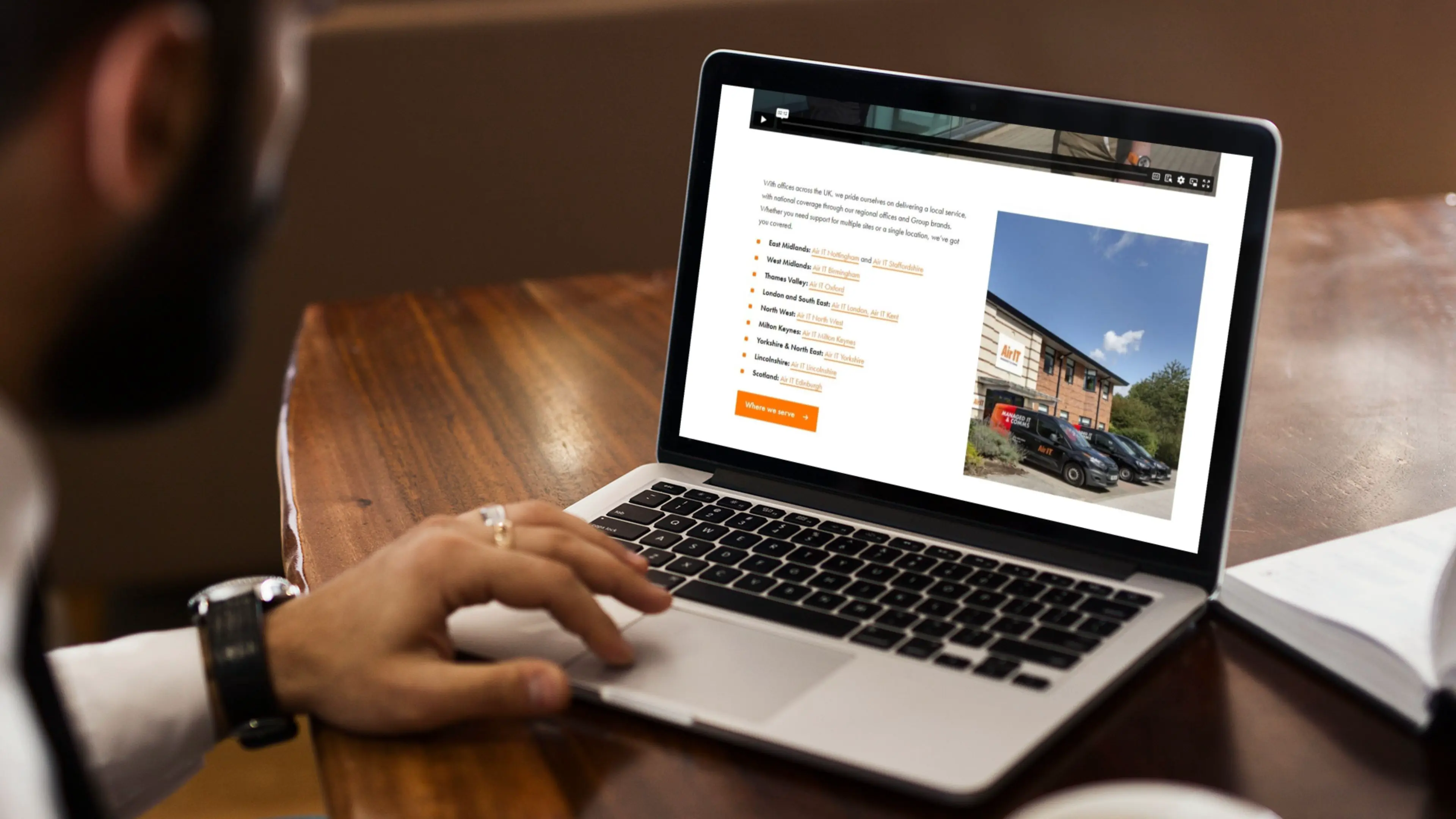
All 13 websites were successfully consolidated into a single Air IT platform. Not one migration caused a measurable loss in organic traffic - the careful redirect strategy and phased approach protected the search equity each legacy site had built.
SEO visibility across the combined entity increased by 60%, driven by consolidated domain authority and higher-quality, non-duplicated content. The unified site now ranks more consistently for the terms that matter to Air IT’s target market, rather than 13 separate sites competing with each other.
Support costs dropped by 80%. The marketing team went from maintaining 13 separate platforms - several of which required developer involvement for basic updates - to managing a single system. That freed up time and budget that had been consumed by routine maintenance across legacy sites.
The operational benefit extended beyond marketing. The sales team reported that the unified digital presence was making conversations with prospects simpler. Instead of explaining the relationship between Air IT and a legacy brand, they could point to a single site that told a clear, consistent story.
Most importantly, the platform was built to scale. When Air IT completed further acquisitions after the initial consolidation, new sites were migrated into the existing structure using the same proven process - each within the same two-week window.