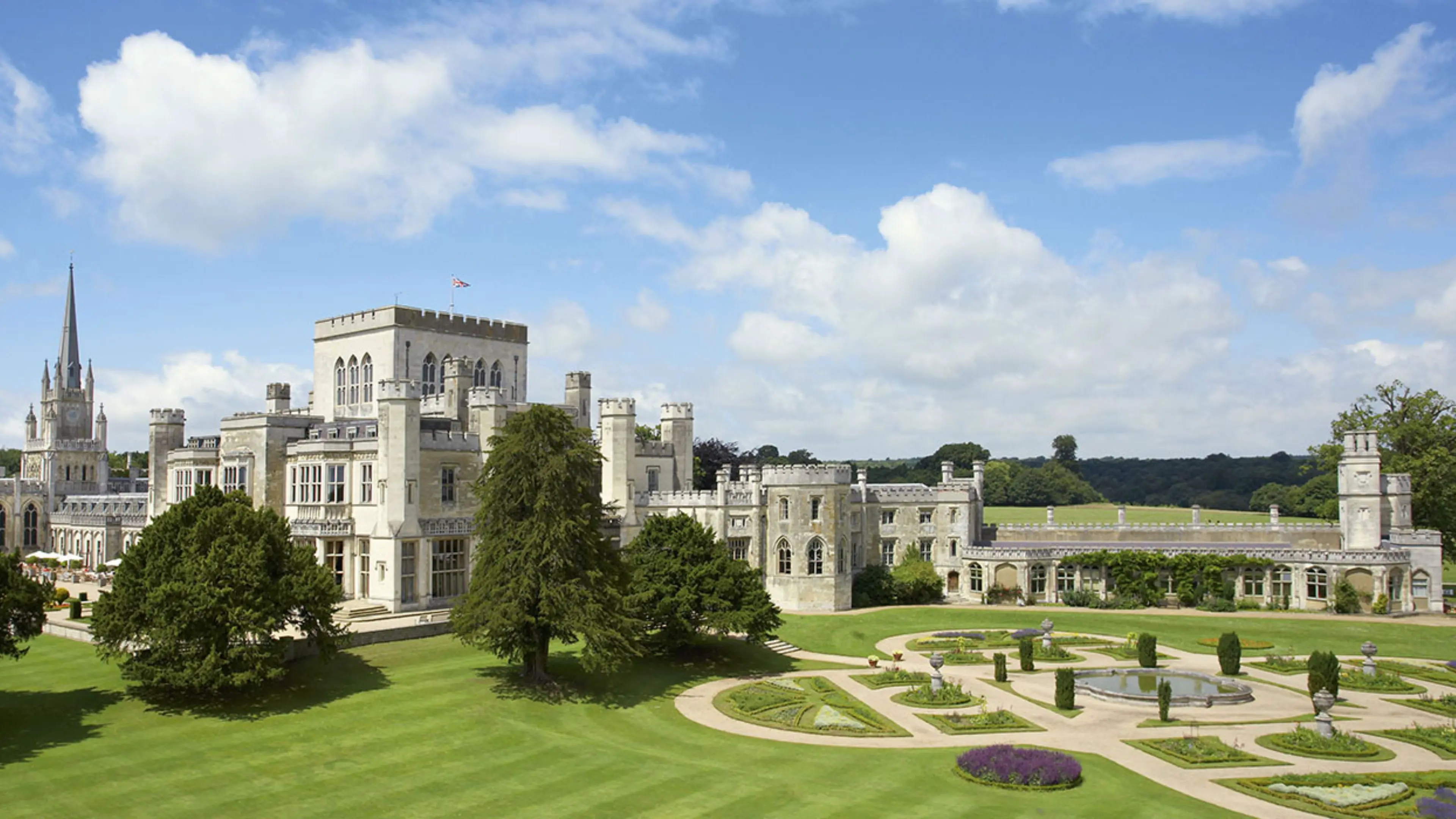
Hult Ashridge Business School is one of the world's most recognised institutions for executive education and leadership development. With a 200-year history, a global alumni network, and a campus at the grade I-listed Ashridge House in Hertfordshire, it operates across two distinct audiences: senior executives and organisations seeking leadership and MBA programmes, and corporate clients and individuals booking the estate for events and retreats.
By the time Distinction was engaged, the school's digital presence bore little relation to either of those audiences. Hult Ashridge had accumulated 60 separate websites, running across 14 different content management systems. Some had been inherited through organisational changes. Others had been created for specific campaigns or programmes and never decommissioned. A few predated the current marketing team entirely.
The result was a digital estate that nobody fully controlled. Content was duplicated, inconsistent, and in places simply wrong. Prospective students looking for programme information could land on any number of sites, many of which had not been updated in years. The navigation between the education offer and the events venue was unclear. And behind the scenes, the IT team was spending a disproportionate share of its time and budget maintaining systems that were unsupported, incompatible with each other, and impossible to update quickly.
The school's VP of Communications put it plainly: the digital presence was not reflecting the quality of the institution. For an organisation competing globally for senior executive students - a highly considered purchase with a long decision cycle - a fragmented, unreliable digital experience was costing them enquiries they would never know they had lost.
"Working with Distinction was a pleasure. Their team brought a strong balance of technical skills, stakeholder management, and commercial acumen - all of which were pivotal to this project. They understood that this was not just a website consolidation. It was about giving two very different audiences a digital experience that actually reflected the quality of what we offer."
We started with a structured assessment. Over two weeks, we interviewed stakeholders across marketing, IT, admissions, and the events team, audited the full estate of 60 websites, and mapped how prospective students and event bookers actually moved through the existing digital presence.
The findings were clear. The estate did not need incremental improvement - it needed to be rebuilt around the two audiences it existed to serve. Every site, page, and content asset needed to be evaluated against a simple question: does this help a prospective student understand and apply for a programme, or does it help a corporate client book the estate? If it did neither, it had no place in the new structure.
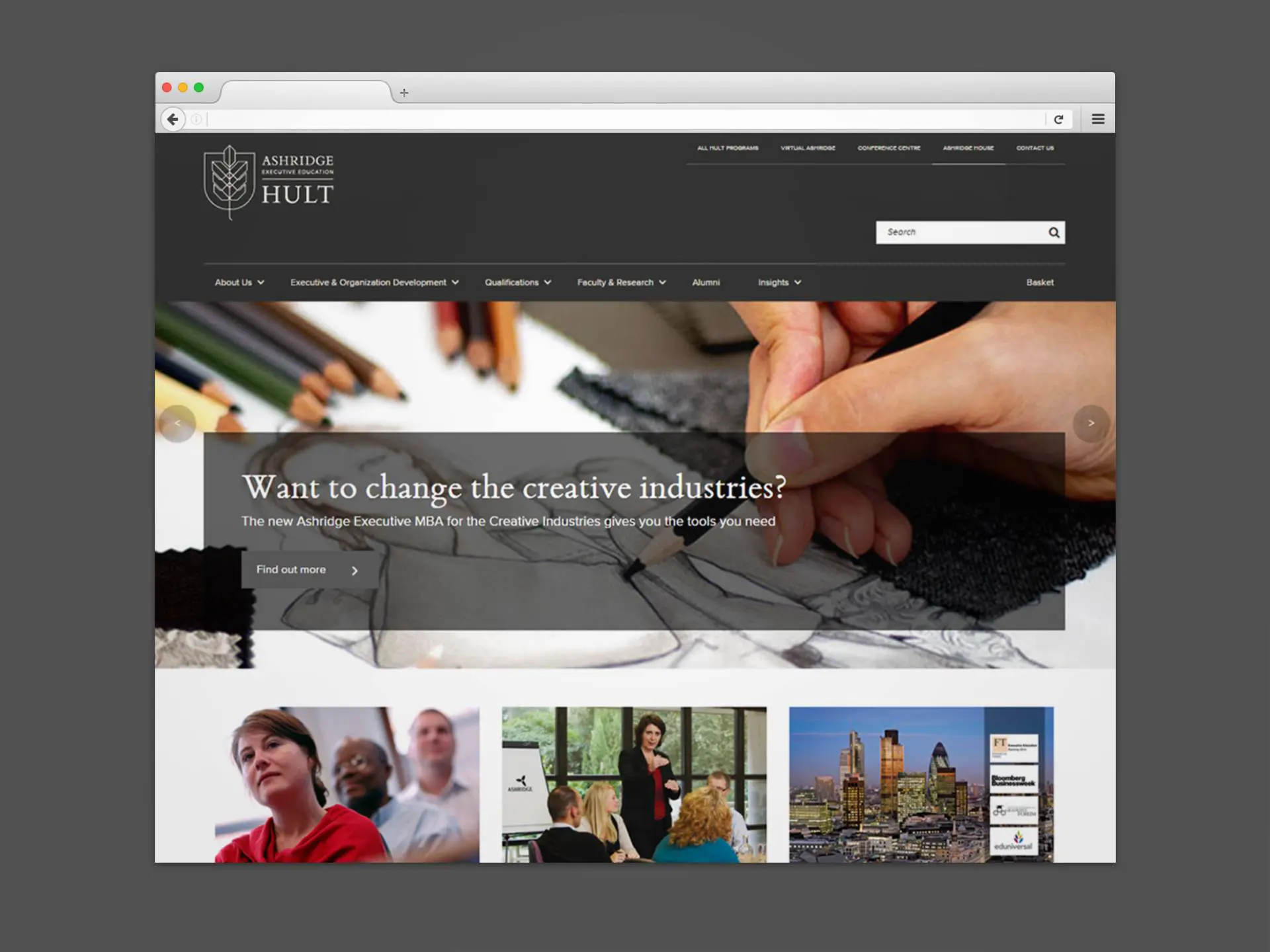
The consolidation strategy was built around that principle. We reduced 60 websites to two: one dedicated to Hult Ashridge's educational programmes - MBA, executive education, and leadership development - and one dedicated to Ashridge House as an events and venue destination. The 14 CMS platforms were replaced with a single system that both teams could use, with separate content areas, workflows, and editorial controls for each audience.
The education site was designed around the decision-making process of a senior executive considering a significant personal or organisational investment. Programme pages were restructured to lead with outcomes - what participants achieve and how - rather than module lists and delivery formats. The application path was simplified and made visible from every relevant entry point on the site. Faculty profiles, thought leadership, and alumni stories were connected directly to the programmes they were relevant to.
The events site was built to serve a different kind of buyer: event managers and corporate buyers at organisations looking for a distinctive venue. The focus was on making the estate's facilities, capacity, and logistical details easy to find and act on - with a clear enquiry path at every stage.
The entire project - assessment, strategy, design, build, content migration, and launch - was delivered in 20 weeks, without disrupting the school's active admissions or events operations during delivery.
The immediate impact was financial. Annual IT costs fell by $1.6 million - the direct result of decommissioning unsupported systems, eliminating the overhead of managing 14 separate CMS platforms, and reducing the developer time previously consumed by maintenance across a sprawling, incompatible estate.
The impact on enquiries took longer to show, as expected in a sector with a long consideration cycle. Within six months of launch, programme enquiries through the education site had increased by 38%. The improvement was driven by two things: a significant reduction in the bounce rate on programme pages, where visitors were now finding relevant content rather than landing on outdated information and leaving, and a simpler, more visible application path that converted engaged visitors who had previously dropped off.
The events site saw a comparable improvement in venue enquiry conversion, with corporate clients moving from initial interest to submitted enquiry more quickly than before - a reflection of how much easier the new site made it to find the information needed to make a booking decision.
Internally, the marketing team reported that the shift to a single CMS had changed how they worked. Content that had previously required IT involvement could now be updated directly. Campaign landing pages could be built and published without developer support. And for the first time, both teams - education and events - were working from the same platform, with a consistent view of how the digital presence was performing.